
ABOUT OSCAR
Brief Overview of OSCAR
Please note that information on this page is dated, and is presented here for historical interest purposes
INDEX:
WHAT IS OSCAR?
OSCAR is a fully featured Electronic Medical Records (EMR) software program, designed by doctors for doctors, for use in medical offices. For a quick list of the key program features click here. Besides by physicians, OSCAR is also used by a variety of other front line health care professionals, including registered midwives, social workers, psychologists, nurse practitioners and physiotherapists. OSCAR is an OPEN SOURCE project. To our knowledge OSCAR is the only widely deployed open source EMR system in Canada. The name "OSCAR" is an acronym for "Open Source Clinical Application Resource".
OSCAR's HISTORY:
In 2001, the OSCAR project was started by the Department of Family Medicine at McMaster University (in Hamilton, ON, Canada) with the objective of producing a state of the art web-based EMR to support diverse academic and clinical functions. Since 2001 OSCAR has been implemented in large and small clinics across the country with most users found in Ontario and BC. An increasing number of support companies provide services which include server installation, maintenance, and user training and support. Throughout it's development, the Dept of Family Practice at McMaster University has managed the project and more recently has driven the efforts to get OSCAR through jurisdictional licensing and certification processes in Ontario. In 2012 a not-for-profit entity called "OSCAR-EMR" was incorporated, based in Hamilton, ON, which will oversee ongoing development, Ontario provincial certification and quality management processes and continue the task of centrally maintaining the code base.
USER BASE:
In 2015 there are around 1000 officially funded physicians using OSCAR in Ontario, and we estimated between 700 and 800 unfunded clinician provider users in BC. Absolute user numbers are difficult to estimate because OSCAR is open source, and therefore anyone may download and install the solution.
It should also be noted that OSCAR is now the EMR used by Departments of Family Practice at a number of medical schools, including at McGill, at Queens, at UBC and of course at McMaster.
Internationally there are some OSCAR EMR systems running around the world, for example in Argentina (it has been translated into Spanish). We have also heard about isolated installations in Africa, the Caribbean and in Vietnam. Because of its free license and modest hardware resource requirements, OSCAR seems to be a popular EMR choice with Canadian charitable clinical outreach and relief projects in the developing world.
Overall, the largest numbers of users are in Canada, in Ontario and BC. The true number of Canadian users is probably higher than estimated, because physicians can self-install OSCAR, and, since it is a free open source project, there is no formal central register of users. We therefore rely on voluntary self-report by OSCAR support providers and users to establish usage statistics. For a self-reported Google Map of OSCAR installations across Canada click here.
WHERE CAN I SEE A DEMO?
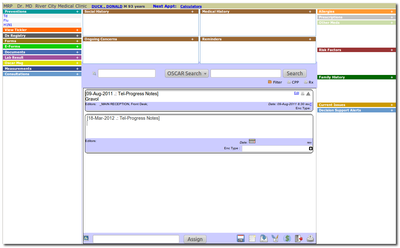
Some screen-shots are posted on this site here. Some OSCAR support providers or developer groups provide demo sites, these are full OSCAR installations open for the public to explore. The best possible demo experience is to visit an actual working OSCAR user near you and see a living, breathing OSCAR system in action. Generally OSCAR users embrace the opportunity to show their EMR off to interested colleagues and help them make good choices.
OPEN SOURCE:
OSCAR is FLOSS (Free libre open source software). The licence is the General Public Licence (GPLv2) which ensures that OSCAR is available with no licensing fees, in perpetuity. The licence also specifically gives rights to people to develop and distribute the software. Since the creation of the Linux operating system in the 90’s, open source software has grown dramatically and has clearly established its viability in the commercial sector. For further info about the open source principle click here.
It should be pointed out that while OSCAR is "free as in free speech", it is certainly not "free as in free beer". There are costs associated with the deployment, maintenance, support and jurisdictional certification of OSCAR. In Ontario for example, end users are obliged to pay a small monthly "certification fee" to McMaster / "OSCAR EMR" to offset the cost of ongoing maintenance of certification requirements, in exchange for the ability to apply for government EMR funding, on a per-funded-physician basis. These fees are in addition to any professional support and maintenance fees users might incur and also apply to instances where physicians are using OSCAR in a self supporting fashion and wish to apply for Ontario govt funding. But taking this into account, the costs of running an OSCAR EMR solution should still be substantially lower than the costs of running a competing proprietary EMR product in the majority of situations.
MORE ABOUT OSCAR's LICENSE:
OSCAR is licensed under a strong free software license, the General Public License version 2 (GPLv2). This means that the developer who has built code for OSCAR owns the copyright to that particular part of the code base. Under the terms of the license others may freely copy and distribute the code so released, as long as they acknowledge attribution, original copyright, and also release any derived works under the same license terms.
This means that OSCAR's licensing, like that of many other open source projects, is complex. McMaster university has contributed the bulk of the huge code base of the project, and so holds GPL copyright to the vast majority of it. There are however, many other contributors who hold copyright to small parts of the code base, for example CAISI in Toronto, and many individual developers from the community. Therefore no single entity may claim complete ownership of OSCAR. In practice however, McMaster is regarded the central developer and owner of the OSCAR code base.
OSCAR COMMUNITY:
OSCAR support companies and users form a close knit community with regional and national group meetings. Key role players in the OSCAR community are as follows:
- McMaster university and "OSCAR EMR" is the non-commercial sponsor, project manager
and development coordinator of the OSCAR project. McMaster also holds
the strong open source license to the bulk of the code base and
they are trusted to maintain the code repository and to ensure the
project remains unified, free and certified with ISO and OntarioMD. The
official repository version of the source code is identified as "OSCAR McMaster".
This serves to differentiate the main trunk from unofficial forked
versions of the OSCAR project that might occasionally appear. In Ontario, McMaster / OSCAR EMR is entitled to levy "certification fees" for the use of OSCAR to offset the cost of achieving and maintaining ISO and jurisdictional provincial certification, thus enabling OSCAR users to apply for government funding.
- The Oscar Canada Users Society "OCUS" is a not-for-profit society incorporated in BC, with a democratically elected board representing the interests of the user community in providing some input to the project. All OSCAR end users are encouraged to become active members of OCUS. You are currently looking at our OCUS website maintained by board volunteers. OCUS board members are actual working physician users of OSCAR. No OCUS board member may have a direct financial profit interest in OSCAR, or in an OSCAR support business, in order to avoid conflict of interest situations arising. If you are already an OSCAR user and you wish to become a member of OCUS, click here.
- OSCAR support providers "OSPs" are independent businesses, who install, maintain and support the OSCAR solution for the end user. They are entitled to levy support fees for this service, and they compete in the open market for the support business. Under the terms of the open source license, OSPs do not have rights to sell licenses for the use of OSCAR, or to sell their own software products directly derived from OSCAR. However under OSCAR's open source license, as it stands in 2012, OSPs are entitled to offer their own licensed independent services or products alongside OSCAR (such as independent billing utilities in provinces where there is no native OSCAR billing utility) as long as these products/services are not directly integrated into the OSCAR codebase. In Ontario OSPs are obligated to subject themselves to a certification and training process administered by McMaster / "OSCAR EMR", in exchange for the right to deploy and support the provincially certified version of OSCAR. As part of the contract OSPs are required to enter into with "OSCAR EMR", they are obligated to collect "certification fees" from their clients, on behalf of OSCAR EMR, to offset the cost of achieving and maintaining ISO 13485 and jurisdictional provincial (Ontario MD CMS 4, Infoway "J" class) certification, thus enabling OSCAR users to apply for government funding in ON.
WHAT IS VENDOR LOCK IN?
Vendor lock in means that once you have invested data in a proprietary system you are stuck. It makes business sense for vendors of proprietary EMR systems to lock you into their format and themselves into your cash. The vendor can name their price for additional features because no-one else can write for the product. New features are often slow to arrive because the vendor has to wait until there is a significant demand for that feature before investing money into developing it. While many modern proprietary EMR systems are very well designed, robust and usable, this satirical website does a great job of illustrating, in a tongue-in-cheek fashion, some of the frustrations doctors have run into while locked into certain proprietary EMR systems.
In contrast to the above, OSCAR is an open platform. Your data is, and always will be, your data.
COMMERCIAL SUPPORT FOR YOUR OSCAR EMR:
The vast majority of doctors using OSCAR choose to pay to have OSCAR installed, and to pay for ongoing support. At OCUS we strongly encourage our members to engage one of the professional OSCAR tech support providers (OSPs), rather then trying to do the installation and maintenance of the EMR system themselves. There are several OSCAR support provider companies, and as the demand for OSCAR continues to increase, there has been a predictable market response, with an increase in the supply of support providers. For an (incomplete) Canada-wide list of OSCAR support providers see: https://oscar-emr.com/get-oscar/ . For an Ontario specific list of OSCAR support providers officially certified by McMaster / OSCAR EMR, please click here.
Even though OSPs may not sell licenses for the use of OSCAR, they are entitled to offer their own licensed independent services or products alongside OSCAR (such as independent billing utilities in provinces where there is no native OSCAR billing utility) as long as these products/services are not directly integrated into the OSCAR codebase.
In Ontario OSPs are obligated to subject themselves to a certification and training process administered by McMaster / "OSCAR EMR", in exchange for the right to deploy and support the provincially certified version of OSCAR. As part of the contract OSPs are required to enter into with "OSCAR EMR", they are obligated to collect "certification fees" from their clients, on behalf of OSCAR EMR, to offset the cost of achieving and maintaining ISO 13485 and jurisdictional provincial (Ontario MD CMS 4, Infoway "J" class) certification, thus enabling OSCAR end users to apply for government funding in ON.
While it is natural in the business world to want to achieve a competitive advantage, the open source mechanism provides important protection to the OSCAR end user from vendor-lock-in situations. Such protection is not available to users of proprietary EMR products. OSCAR users are free to change OSCAR support providers at any time, without the risk of their data being held to ransom. OSCAR support providers compete honestly in the open market, on the basis of true merit and customer service, rather than on the basis of leverage.
WHO IS OSCAR's "VENDOR"?
Many govt EMR funding programs across Canada are structured to engage an EMR "vendor". Yet, in the case of OSCAR, there is no "vendor" in the traditional sense. The term "vendor" implies that a sale is taking place, yet OSCAR software cannot be sold. It has to be free. OSCAR's strong open source license ensures that it will always remain so. OSCAR simply is the finest EMR software no money can buy.
- McMaster university holds the strong free software license for the vast majority of the code base in OSCAR, but no single entity may claim complete ownership of OSCAR (see OSCAR's license). In Ontario, McMaster
university has taken it upon themselves to shoulder the considerable
development effort required to meet provincial EMR certification
conformance criteria.
- A growing number of independent commercial OSCAR support providers
compete for the support business. These "OSPs" may levy fees for tech
support, but none of them have rights to sell licenses to use OSCAR.
- The various provincial government EMR funding agencies are used to dealing with private corporations, so with the arrival of OSCAR many of these authorities were, and still are, somewhat unsure about how exactly to engage with a decentralized open source project. In most provinces OSCAR is therefore not eligible for the same govt funding available for use of certain proprietary EMR systems. Nonetheless, in BC OSCAR is healthy and thriving in the absence of direct government funding and is now the third most installed EMR solution in that province. In Ontario the funding problem has been solved by having McMaster University, by way of a new incorporated not-for-profit entity called "OSCAR EMR" assume a central accrediting role for the OSCAR support providers and user community, and applications for govt funding have to be audited by McMaster prior to approval (this of course applies to Ontario only).
ACCOUNTABILITY:
OSCAR is provided for free with absolutely no warranty or guarantees. Medical physicians are a self regulated profession in Canada, and they are held to certain professional standards. These standards, enforced by the various provincial physician college licensing authorities, apply not only to medical competency and proficiency, but also to medical record keeping. Physicians are the trusted stewards of their patients' medical data, and they have strong obligations to ensure that this data remains private, protected, intact, well organized and available when needed. It is the physician end user who is responsible for the integrity and security of their EMR system, not the developer, not the tech support provider nor the vendor. This principle applies to users of open source OSCAR EMR, just as it does to users of proprietary EMR systems.
In this context OSCAR users are encouraged to practice due diligence when choosing an OSCAR support provider. Partnering with an inexperienced or incompetent support provider can lead to serious professional consequences. As with many things, experience counts. Ask for references! Ask about security protocols. Speak to colleagues who use OSCAR in their practices. You will find that most OSP companies have an excellent reputation and track record.
If you are a new OSCAR user, with an OSCAR system supported by an Ontario OSCAR support provider officially certified by McMaster, you will also be asked to check off a EULA (end user license agreement) at your first log-in, in which you expressly agree to indemnify and release OSCAR EMR and the developers at McMaster from any and all liability arising from and associated with the use of OSCAR.
DEVELOPMENT:
OSCAR is based on a community driven development model with a central project management role played by McMaster / OSCAR EMR. Current contributors to the OSCAR project include:
- Large institutions (e.g. McMaster, McGill & City of Toronto),
- Independent companies (e.g. OSCAR support provider companies)
- User Groups (e.g. OSCAR Canada Users Society)
- Independent clinics or doctors and individual developers.
The main OSCAR development team at McMaster University coordinates community development and maintains the trunk of the source code, referred to as OSCARMcMaster, governed by the not-for-profit entity "OSCAR EMR. Programmers in the community interested in getting involved in OSCAR development can find information on how to get started here and here.
Newly developed code submitted for integration into the OSCAR trunk is subject to an automated review process, that checks that the program will build, and if the coding rules have been followed. Then, if it passes, members of the OSCAR technical committee will review the code. They check if a feature request is referenced in the submission and check that the code is likely to work and play nice with the rest of Oscar. Only then is the code admitted to the source code. Subsequently the code is tested further against real data in beta test sites, and when most of the bugs are ironed out, we get a release of a branch.
UPDATES:
Currently, the OSCARMcMaster trunk repository for the source code is updated by the developers twice a year, in April and October, with clear outlines for users in advance, of what
each new release will contain. Updates are overseen by a technical committee and a product management committee. Once the updates are officially released, the various OSCAR support providers in the market are free to update their customer’s
systems with the newer versions, at their, and their clients' discretion.
The various OSCAR support providers are also free to do some custom programming and development work for specific clients, however, under the open source license rules, they are obligated to voluntarily share these improvements back to the main code repository. To read more please refer to OSCARs "open source code of ethical conduct" here.
STANDARDS, CONFORMANCE AND FEATURES:
In Ontario, where a standards-based approach was taken to EMR selection, OSCAR McMaster has easily passed all rounds of conformance testing, including the rigorous CMS Specification v3.0 from OntarioMD in February 2009. OSCAR McMaster has registered for OntarioMD Specification 4.0 Validation Testing, and has achieved ISO 13485:2003 Certification as well as Infoway "J" class jurisdictional certification for Ontario. In 2012 the not-for-profit entity "OSCAR EMR" was incorporated to centrally oversee and maintain the ongoing certification process for OSCAR.
The International Standards Organisation (ISO) 13485:2003 standard is defined specifically for medical devices and is based on the broader ISO 9001 standards, but ISO 13485 certificants are held to a higher level of conformance.
OSCAR currently does not (yet) meet Infoway "N" class national certification, since it meets government conformance testing in Ontario, but not in multiple additional provinces.
OSCAR is able to communicate via most widely used versions of HL7 (Health Level Seven International), and thus can export data as mandated by the OntarioMD standards and can import labs. Oscar has an Excelleris interface for lab download and is in the process of completing its interface with BC’s Interior Health Authority’s Physician Office Integration program so that regional patient reports can be directly downloaded.
OSCAR can be run as a local server installation or as a remotely hosted system.
For a listing of OSCAR's main features, click here.
CHRONIC DISEASE MANAGEMENT (CDM) TOOLS:
OSCAR has excellent Chronic Disease Management Flow Sheets for Diabetes, Hypertension, CHF, COPD, asthma, HIV and INR, as well as Chronic Disease Management audit tools. There are also Maternity Care forms, reports and audit tools, as well as Preventive Care and Immunization Modules, and many other features.
STABILITY:
OSCAR is highly stable. Running on Linux servers means that the server operating system is also stable. Production OSCAR systems are typically installed on top of the latest Linux Ubuntu LTS server operating system. This is the same operating system used to run Wikipedia's web-servers since 2008. New updates of OSCAR are tested for stability prior to release in the McMaster teaching clinics.
SECURITY:
Doctors are trusted with the safekeeping of their patients' confidential medical information and thus take the security of their EMR system very seriously. The concept of EMR security can be divided into three categories: Security of the servers, security of the traffic between server and workstation and security of the workstation devices.
- Server security: Most OSCAR support providers do a fine job of electronically securing a local server installation of OSCAR from Internet attack. It should be noted that the self-install version of OSCAR posted on this
website will need some basic security hardening (changing passwords
from the default settings and such) before it would be safe for
production use. It should also be noted that it is good practice to
physically secure your servers behind a sturdy locked door in your office and have an alarm system in place. If you are very concerned about the physical security of local servers, these can be set up with their database encrypted, making it impossible to hack into them even with physical access from the console. Furthermore the automatic daily on-site and off-site backup files are usually set
up to be encrypted. In some provinces govt EMR funding authorities feel uncomfortable leaving server security in the hands of individual physicians, and thus mandate that all EMR solutions have to be remotely and centrally hosted (ASP/cloud hosted) by the support provider/vendor in a secured server farm to be eligible for funding. Some physicians on the other hand feel uncomfortable leaving server security in the hands of govt regulators or EMR vendors, and prefer to hold their EMR data themselves on a local server. OSCAR can deployed equally effectively as either a local server or a remotely hosted installation. Both types of OSCAR installation can be adequately secured. With the price of server hardware decreasing and the reliability of Internet connections increasing, this has become less of a technical matter and more of a control issue.
- Connection security: OSCAR uses something called "Transport Layer Security" (TLS/SSL) to encrypt the information flowing between the server and the browser/clients/workstations connected to it. By encrypting the communication between server and workstations, OSCAR users are protected against "eavesdropping" breaches. This is the same open source technology that banks around the world use to secure their online banking portals for their clients. This widely used approach of securely encrypting point-to-point information sent over an insecure network (the Internet) is a flexible, light-weight, proven, cost effective and practical solution.
- Workstation security: OSCAR uses a double password approach for user log-in, much like many banks use for online banking access. One password is set by the user, the other is set by the OSCAR system administrator. Most security breaches in any IT system occur due to user carelessness,
not due to hacker attack or failure of security technology. It is therefore imperative to implement basic user workstation security, such as screen locks, updated security software and to generally follow good security habits such as using nominal user IDs, not sharing user IDs, using strong passwords and to rotate passwords regularly. This would be important for any type of EMR (and no, those little security fobs don't necessarily make it foolproof, since those could be shared among uncooperative users too).
CAN OSCAR RUN "IN THE CLOUD"?
Yes, OSCAR can be installed either as a local server solution, or it can be remotely hosted on someone else's server. With a local server solution the server becomes the "single point of failure". Most OSPs will therefore put a twinned backup server right next to the main server, to take over in the unlikely event of server failure. With a remotely hosted EMR solution, the Internet connection becomes the single point of failure. Internet outages do occur and can be very frustrating. Most OSPs will tell you that the costs of local server OSCAR versus cloud/ASP/remote hosted OSCAR are on par, with local server being marginally cheaper these days. Some OSPs will say that it is easier for them to secure, update and maintain their own server farms than a local server in your office. With server hardware prices dropping and Internet reliability improving, this issue increasingly becomes one of control rather than technical consideration. You will want to think carefully about where your data is held physically, how and where it is backed up and secured, and whom you trust to look after data security and integrity for you. Increasingly patients are starting to have opinions about these issues too.
WHAT ABOUT SPEECH RECOGNITION SOFTWARE? DOES THAT WORK WITH OSCAR?
Yes it does. Many OSCAR users do just that to generate their case notes and letters in the EMR. Since OSCAR is designed as a free-text type EMR (as opposed to a structured-input type EMR) it is a good fit with proprietary software such as "Dragon" or "MacSpeech" running on the workstation PC, and most browsers, including Firefox, will work just fine with Dragon. Many users just pick up the basic version of Dragon in their neighbourhood electronics store and start dictating, but there are a also a number of "Dragon support providers" in the market, who will install a proper networked, medical edition of Dragon for you and provide support, training and dictation equipment. If you do it yourself, remember that you want a newish computer with lots of RAM and a good quality USB microphone headset to get the best results. Also be prepared to spend a bit of time familiarizing yourself with the software and the processes involved. Have a look at this impressive YouTube clip demonstrating the use of Dragon to control the OSCAR UI.
DOES OSCAR RUN ON A MAC?
Yes it does. This is actually one of the advantages of the modern web-server/web-browser platform OSCAR sits on. There are many enthusiastic Mac users in the OSCAR community. The recommended application platform for OSCAR on the client/workstation side is the Firefox browser. Many OSCAR users also use the Chrome browser. Any device that can run a browser can be pointed to the OSCAR web server, including PC, Mac, Linux, Android or iPad tablets, smart-phones etc., although some of OSCAR's features might not run reliably on all tablets.
TESTIMONIALS:
To read more about what users say about OSCAR, click here.
Sue Harris: Past Head of Family Practice, BC Children's & Women's Hospital & BC Family Physician of the Year 2008
“Over the last 9 years I have had personal experience with three different electronic medical records. There is no question in my mind about which provides the best options for a family practice office. OSCAR is firstly a patient-centered record which provides evidenced-based care in a cost-effective manner which is not intimidating. Given that software is free and service charges are much less, OSCAR provides ongoing savings for those who are committed to an EMR. There are also OSCAR options for the patient to access parts of his or her own chart. In addition, OSCAR is flexible and can be altered readily for new guidelines, practice recommendations and fee schedules. Finally OSCAR is built on a community of practice: physicians across the country sharing a common goal: to provide high quality care to patients through communication and working together. This is a model for the electronic age and OSCAR should be considered by any family physician looking to an electronic health record and new way of practice.”
To find out more about becoming part of the OSCAR community click here.
Contact Us:
For general inquiries to the directors of OCUS (Oscar Canada Users Society) please send your email to:
OscarCanadaUserSociety@gmail.com
Document Actions